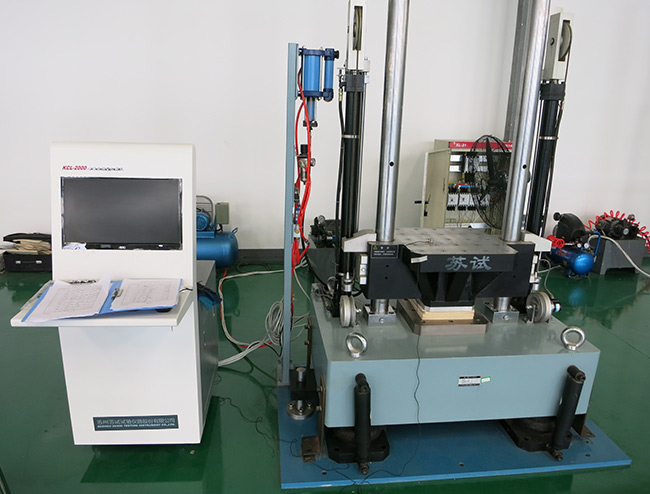
Mechanical shock testing is a laboratory test that simulates a series of shocks a product may experience in its working environment, to verify whether the product functions properly and whether any performance failure occurs. Various shock environments exist during the actual storage, transportation and use of products, such as shocks generated by vehicle braking and by collisions during cargo handling.
The technical parameters of shock testing include peak acceleration, pulse duration, velocity change (half-sine, terminal-peak sawtooth and trapezoidal pulses) and waveform selection. A conventional mechanical shock test requires 3 shocks per face, 18 shocks in total for 6 faces. Mechanical shock and impact (bump) testing can identify mechanical weak points and verify the structural integrity and reliability of the product.
Mechanical shock generally involves high acceleration over a short duration, such as mechanical impacts in the natural environment. Mechanical shock may adversely affect the structural and functional integrity of products. In the laboratory, mechanical shock waveforms fall into three types: half-sine, trapezoidal (square wave) and triangular (initial-peak sawtooth and terminal-peak sawtooth).
The cost of mechanical shock testing depends on the test scope and duration; the longer the test time, the higher the cost.









 WeChat Official Account
 Submit successfully