Test Overview
Vibration testing artificially simulates in the laboratory the various vibration environments that products (generally electrical and electronic products) encounter during storage, transportation, installation and use, in order to evaluate whether a product can withstand the various environmental vibrations and operate normally without failure.
Test Purpose
Vibration testing allows the reliability of a product to be analysed and evaluated before it leaves the factory, reducing the probability of later defective products, and also helps to define the requirements and standards for product design and function.
Application Scope
Electrical and electronic products have a high demand for vibration testing, because most electronic products are precision products, such as mobile phones and tablets, with delicate internal structures and components that are strongly affected by vibration. It is therefore necessary to control the impact of vibration factors on product reliability.
Types of Vibration Testing
Reliability vibration testing is generally divided into two types: sine (sinusoidal) vibration testing and random vibration testing. Sine vibration is the test method most frequently used in laboratories. It mainly simulates the vibration generated by rotation, pulsation and oscillation (as found on ships, aircraft, vehicles and spacecraft), as well as structural resonance frequency analysis and resonance dwell verification. It is further divided into swept-frequency vibration and fixed-frequency vibration; severity depends on the frequency range, amplitude and test duration. Random vibration is used to evaluate the vibration withstand strength of the overall product structure and the transportation environment in packaged condition; severity depends on the frequency range, GRMS, test duration and axes.
1. Sine vibration testing: the specimen is subjected to sinusoidal vibration, either fixed-frequency sine or swept-frequency sine vibration.
2. Random vibration testing: the specimen is subjected to random vibration, which by frequency bandwidth is divided into broadband random vibration testing and narrowband random vibration testing.
Test Standards
Sine vibration: GB/T 2423.10, IEC 60068-2-6, EN 60068-2-6, ISO 8318, GB/T 4857.10, ISO 2247, GB/T 4857.7
Random vibration: GB/T 2423.56, IEC 60068-2-64
Test Parameters
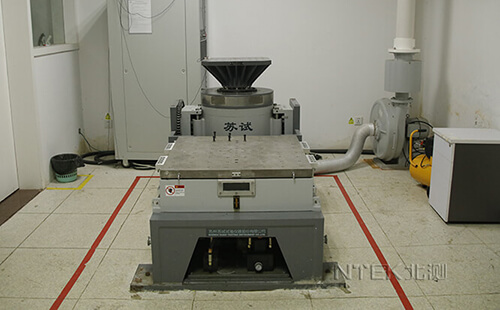
Shaker parameters: maximum force, maximum acceleration, maximum velocity, maximum displacement, table dimensions and weight, table resonance frequency, and frequency range of the shaker.
Specimen parameters: specimen dimensions, specimen weight and test parameters.
Test Equipment and Instruments









 WeChat Official Account
 Submit successfully