Automotive electronics qualification relies mainly on the standards of the Automotive Electronics Council (AEC), including AEC-Q100 for integrated circuits and AEC-Q104 for multi-chip modules. The NTEK automotive component laboratory has identified six main differences between AEC-Q104 and AEC-Q100.
1. Group H and the principle of using existing qualification data
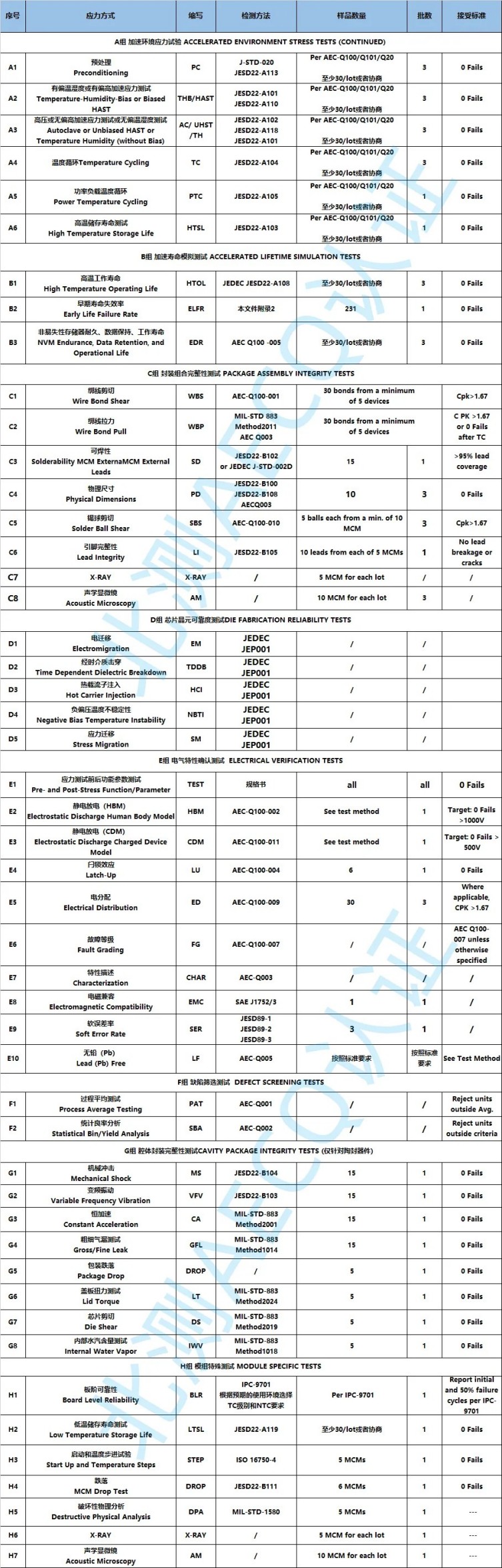
AEC-Q104 is divided into eight groups, A to H. One key principle is that if all components used on the MCM - passive devices such as resistors, capacitors and inductors, discrete diodes and the ICs themselves - have already passed AEC-Q100, AEC-Q101 or AEC-Q200 before assembly, the MCM product only needs the seven tests within Group H. These are four reliability tests, namely TCT temperature cycling, drop, low temperature storage life (LTSL) and start up and temperature steps (STEP), and three failure inspections, namely X-ray, acoustic microscopy (AM) and destructive physical analysis (DPA).
If the components have not previously passed AEC-Q100, AEC-Q101 and AEC-Q200, test items must be selected from the 49 tests across the eight groups A to H according to the product application, and the verification workload becomes considerably larger.
2. Mandatory test sequence
AEC-Q100 tests can be carried out individually, but AEC-Q104 adds sequential testing to reflect the composite environment an MCM experiences in a vehicle, which makes qualification harder to pass. High temperature operating life (HTOL), for example, must be completed before thermal shock (TS), and the order must be followed.
3. Additional test items
AEC-Q104 adds the Group H test items specific to MCMs and also adds thermal shock (TS) and visual inspection for ion migration (VISM) to component level reliability testing.
4. Revised ESD specifications
In view of the complexity of the components inside an MCM, AEC-Q104 lowers the minimum human body model (HBM) requirement from the 2 kV defined in AEC-Q100 to 1 kV. For the charged device model (CDM), AEC-Q100 requires 750 V at corner pins and 500 V elsewhere, whereas AEC-Q104 applies a uniform 500 V regardless of pin-out position.
5. Reduced sample quantities
AEC-Q100 requires 77 samples from each of 3 lots, whereas AEC-Q104, taking account of the higher cost of complex products such as MCMs, optimises the sample quantity to 30 samples from each of 3 lots.
6. First definition of automotive board level reliability
Board level reliability (BLR) is the internationally used method of verifying the solder joint strength of an IC mounted on a PCB and is a routine test item for handheld devices. As automotive electronic systems have become more complex and more ICs are used in vehicles, BLR has gradually become an important automotive test item. Not only have tier-one vehicle makers such as Bosch, Continental and TRW developed their own validation methods for it, but AEC-Q104 also defines the board level reliability testing required for automotive electronics.
Although the BLR items defined in AEC-Q104 are limited to TCT temperature cycling, drop, low temperature storage life (LTSL) and start up and temperature steps (STEP), and do not yet fully match tier-one customer specifications, it is a major step forward in developing a common automotive board level reliability standard.
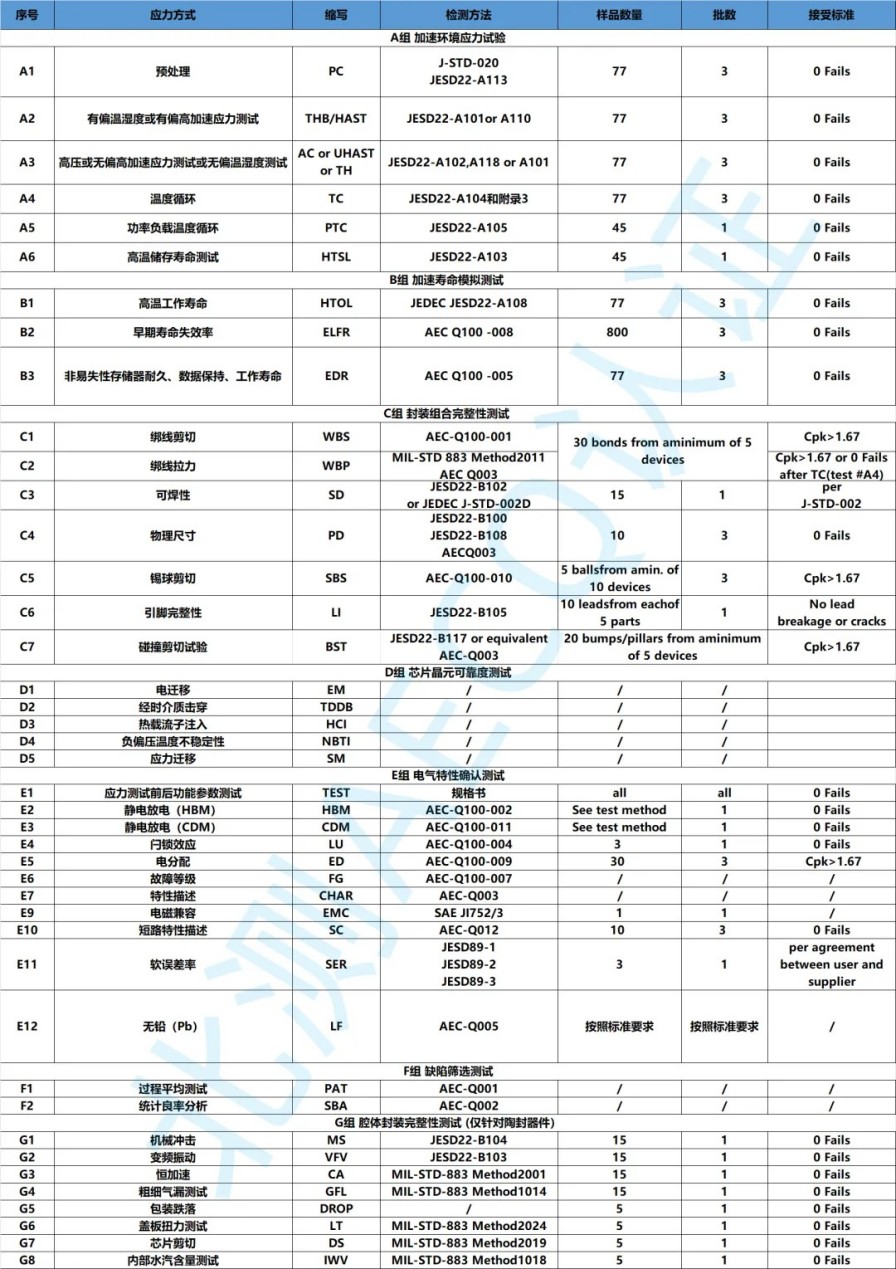
NTEK testing capability against AEC-Q100 requirements
NTEK testing capability against AEC-Q104 requirements
About NTEK
NTEK Group was founded in 2009 and is headquartered in Shenzhen. The group provides quality research and technical services covering R&D verification, inspection and testing, failure analysis, simulation and market access for intelligent connected vehicles, electronic communications and new energy.
NTEK has extensive experience in automotive-grade electronic certification and has helped more than 100 companies pass AEC-Q series certification, confirming the quality and reliability of each chip case against AEC-Q100. Driven by the need of vehicle makers to localise automotive-grade chips and supported by the domestic semiconductor industry, NTEK provides comprehensive testing and certification services, applying AEC-Q100 automotive standards to control the safety and quality of automotive chips, supporting the growth of domestic automotive-grade chips and adding new momentum to the intelligent vehicle safety system.









 WeChat Official Account
 Submit successfully